AwesomeGCP started with the YouTube channel - AwesomeGCP, where I took a different approach based on my experiences and some initial understanding of the science of learning. We learn better when challenged, rather than when passively consuming content. I start with a question that challenges the viewer before going into a detailed explanation. According to learning science, this approach is more effective. Yet, I couldn't ensure the viewer was actually stopping and thinking before going to the explanation. With this site, awesomegcp.com, I believe I can get better at it.
Most attempted learning is passive, reading blog posts and watching long video tutorials. While these materials feel convenient, they often fail when it is time to build real systems, being effective at your job, or as an emergent effect, sitting for certification exams. Learners nod along with an expert on screen, but when faced with an empty console or an exam question, they get stuck.
To solve this, I built awesomegcp.com around an active Question → Think → Learn → Answer approach. I designed this platform around some key principles of learning science, of which I'm a dilettante.
Here is my understanding of how learning works, why simple question-and-answer formats have limits, how this platform structure solves those problems, and how the learning support fades into the background so as not to be a hindrance as you get better.
A Brief Introduction to the Science of Learning
The science of learning combines cognitive psychology, neuroscience, and educational research to study how the human brain processes, stores, and uses information. Understanding a few basic ideas explains why passive studying fails and why structured practice works:
-
The Forgetting Curve: First identified by Hermann Ebbinghaus, the forgetting curve shows
how quickly our brains lose newly acquired information. Without active review or retrieval, memory
decays
exponentially, and learners often forget the majority of new details within hours or days.
Actively
retrieving information resets this decay and flattens the curve, turning fragile memory into durable,
long-term memory.
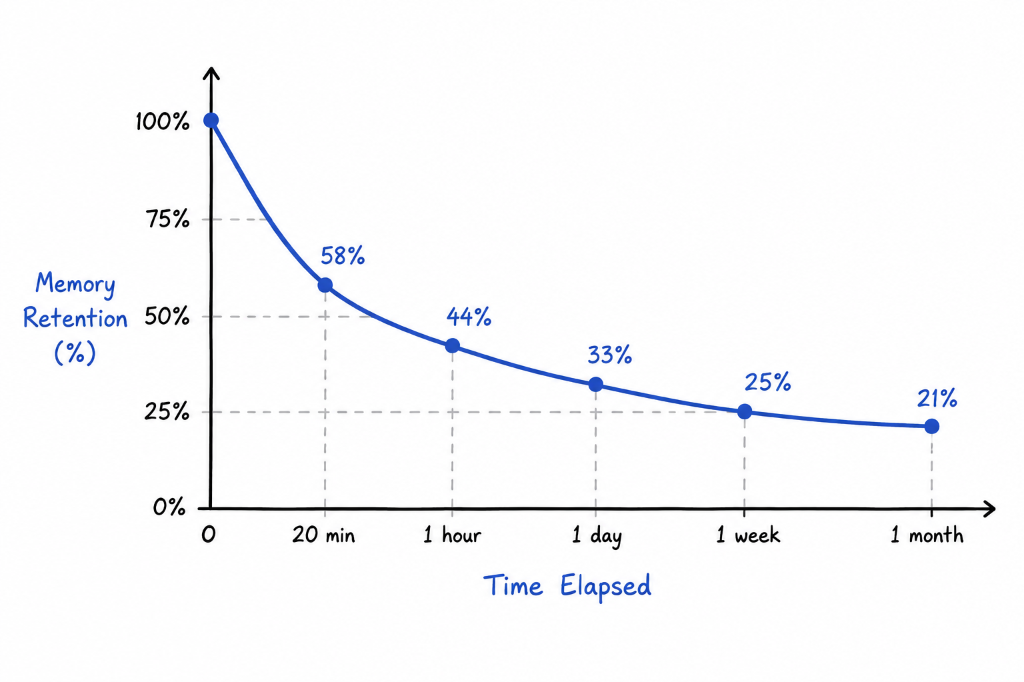
The Ebbinghaus Forgetting Curve demonstrates how rapidly memory retention drops over time without review. 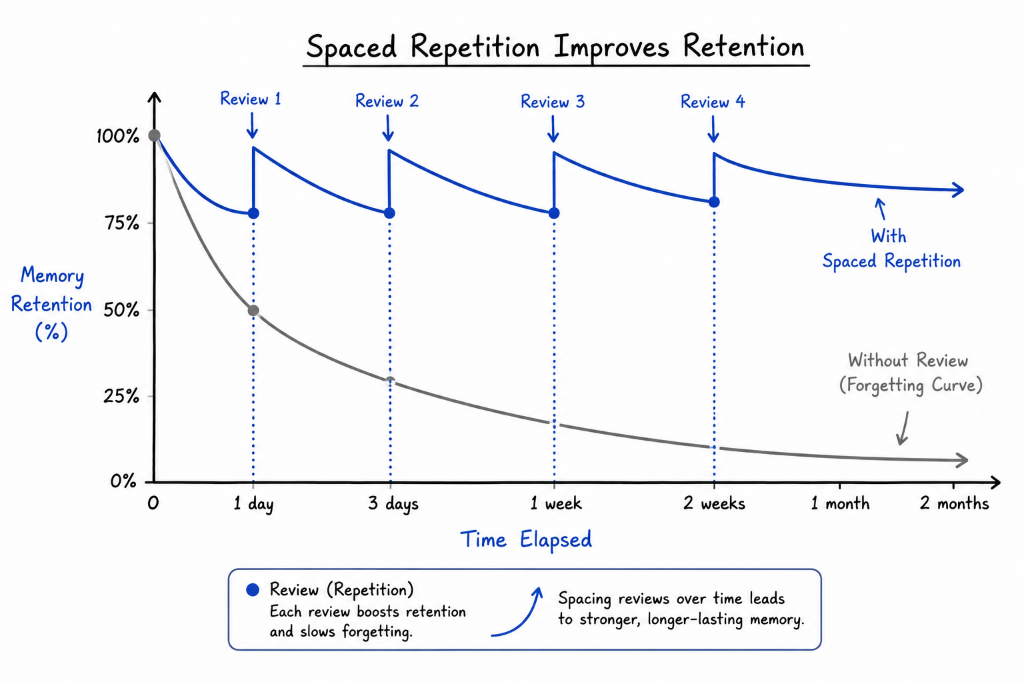
Spaced repetition actively interrupts memory decay, progressively flattening the forgetting curve and solidifying long-term retention. Watching videos and scanning articles have utility in building familiarity - you kinda know the terms and overarching purpose. However, there is little tangible impact on recall/remembering or applicability.
- Working Memory and Cognitive Load: Working memory is the mental workbench where you actively hold and process new details. Too much information overwhelms it, spilling over like a full cup. We need to build up knowledge in chunks. Long form video or written content is not conducive to this. We need to be able to pause, ponder, and then continue. We need to be able to skim to specific points, skip known parts, spend time on topics that we don't know much about. In my experience creating long form content and consuming it, it tries to be everything for everybody, making it time consuming to identify parts that you care about.
-
Schemas: A schema is an organized mental framework stored in long-term memory. Once you
build a schema (such as how cloud storage classes differ), that entire bundle of concepts functions as a
single unit, freeing up your working memory for higher-level problem-solving. p.s. tricks like memory
palaces is not understanding.
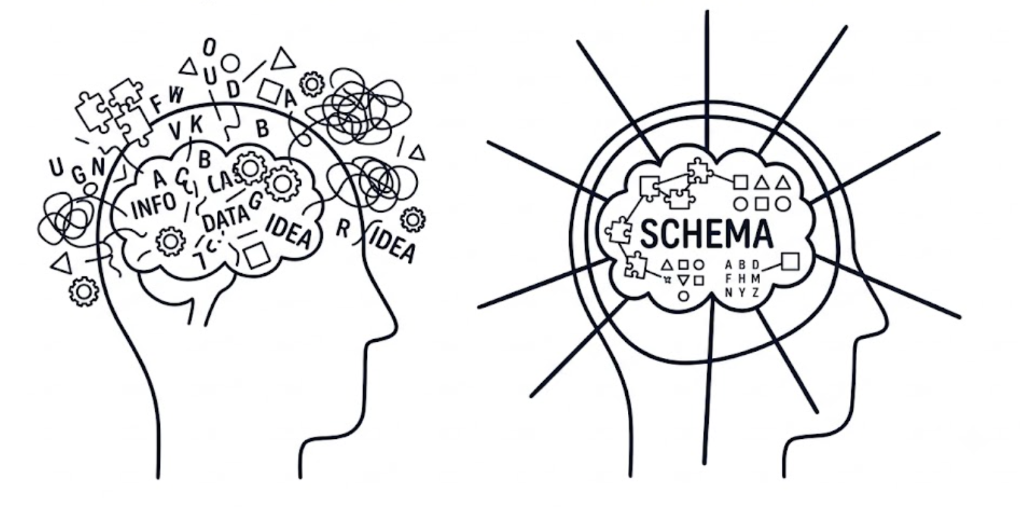
Schemas structure disorganized information into unified mental models, freeing up working memory for higher-level problem-solving. - Active Recall and the Testing Effect: Reading notes or watching videos is passive recognition. Active recall means deliberately pulling information out of your own memory. Experiments show that testing yourself is not just an assessment tool; the act of retrieval itself strengthens memory connections and dramatically improves long-term retention. (Creating content and teaching is even more effective for mastery of a subject, but of course, you give up on wider learning.)
- The Illusion of Competence: Passive reading and watching fluent instructors feel effortless. Because the explanation flows smoothly, the brain mistakes that familiarity for actual mastery. You only discover you do not know the material when forced to retrieve it or apply it without help.
-
Desirable Difficulties: This principle states that making
learning tasks moderately harder and requiring more mental effort leads to better retention and transfer. If
a task feels too easy, immediate performance looks fine, but it's impact is poor.
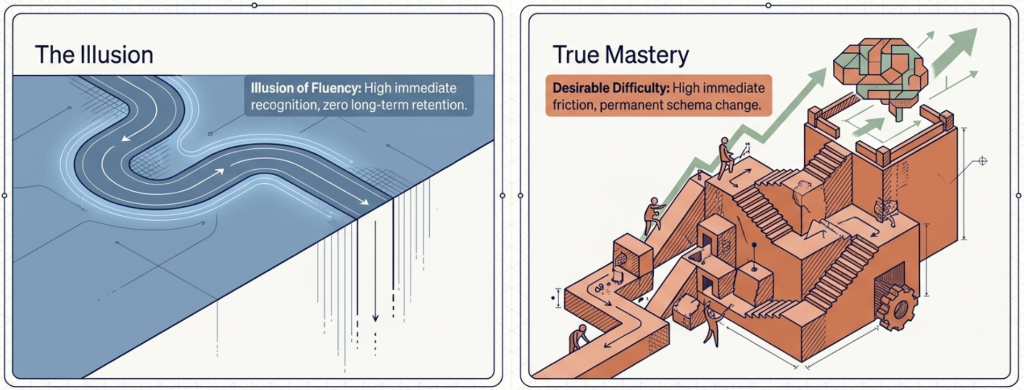
The Illusion of Fluency delivers effortless immediate recognition with little retention, whereas Desirable Difficulty introduces productive friction that drives true mastery and lasting schema construction. Yet, difficulty levels have to be optimum. Too difficult and people may get discouraged and drop off. Too easy, and they'll find no reason to waste their time. So there has to be a spectrum of difficulty matching the learner's levels. Interestingly, this is not in one direction of difficulty. At times you may need more foundational knowledge on certain topics. So both has to be availble but distinct to choose from. (See Expertise Reversal Effect also below).
- The Generation Effect: When learners try to produce an answer, solution, or procedure themselves rather than just being handed the answer, they understand and retain the material much better.
- The Expertise Reversal Effect: Instructional techniques that help beginners can actually hinder learners as they gain experience. Beginners need heavy guidance and worked examples, whereas advanced learners learn better through independent problem-solving.
- Dual Coding: People process visual and verbal information through separate channels. Combining clear visual diagrams with concise text improves comprehension compared to text alone. I've also heard that people listen to audio books while reading the physical book. They claim it is effective, most likely because your brain processes the information through two separate channels.
The Benefits of the AwesomeGCP Question → Think → Learn → Answer Method
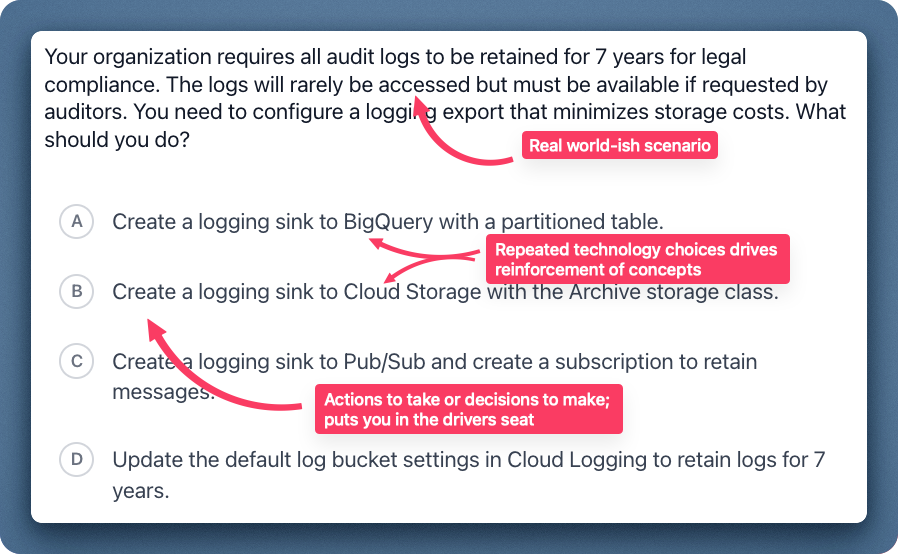
By centering awesomegcp.com on active problem-solving, I incorporated several core advantages:
- Fighting the Forgetting Curve: Passive reading does very little to stop memory decay. Forcing retrieval right after learning interrupts the forgetting curve, resetting memory strength at a higher baseline.
- Shattering the Illusion of Competence: When you face a specific architectural scenario before seeing the answer, you must test your knowledge immediately. You instantly see the gap between what you actually understand and what you merely recognize.
- Durable Long-Term Retention: Forcing your brain to reconstruct memories builds stronger neural pathways than re-reading notes.
- Better Knowledge Transfer: Cloud engineering requires applying concepts to novel business problems. Answering scenario-based questions trains you to transfer knowledge to new situations - a completely new and unexpected problem at work can be better reasoned through. Even novel, unfamiliar questions on the certification exam can be reasoned through.
The Limits of the General Q&A Approach
While testing is powerful, simply throwing practice questions at someone is not enough. Cognitive research highlights several key flaws in raw Q&A:
- Cognitive Overload for Beginners: When a beginner lacks basic schemas (i.e. mental models), open-ended problem-solving floods their working memory. Novices learn faster and retain more from guided study and worked examples than from unguided problem solving.
- High Element Interactivity: Testing learners on complex materials before they have an organized mental framework can reduce the benefits of retrieval practice.
- The “Feeling of Learning” Trap: Research shows that active problem-solving feels dis-fluent and mentally taxing. Because of this struggle, students often feel they are learning less from active engagement than from a smooth, polished lecture. In reality, their actual test scores are much higher, but I cannot ignore the negative mental optics for the learner (psycho cybernetics, if you will).
- Encoding Misconceptions: If a student guesses on a question and does not receive clear corrective feedback, they risk cementing that mistake into long-term memory.
- Narrow Focus: Posing a question before teaching can cause learners to focus only on the specific fact tested, causing them to ignore surrounding foundational concepts.
I have to overcome these too to make AwesomeGCP.com effective for learners.
How I Designed AwesomeGCP.com to Solve These Limitations
To fix these problems, I designed a structured question framework that surrounds every problem with cognitive scaffolding. Each section serves a precise purpose:
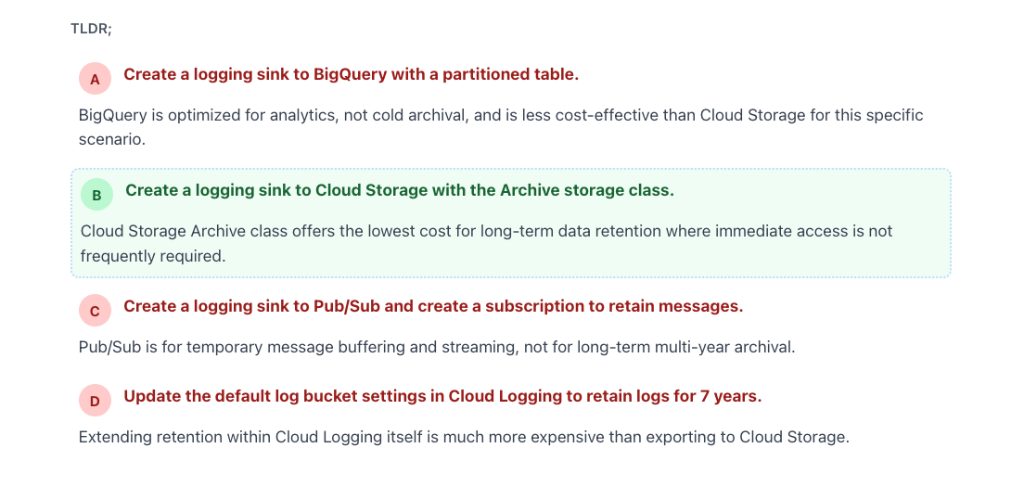
1. The Role of the tldr
The tldr plays three crucial roles:
- Cognitive Load Reduction: Reading multiple long explanations can flood working memory.
Placing a one-sentence
tldrbefore the full explanation highlights the essential point immediately, giving the learner a clear anchor before they dive into deeper technical details. - Rapid Calibration: When a learner picks an incorrect option, the
tldrquickly points out the exact reason that option failed, correcting the mistake instantly without making them dig through long paragraphs. - Efficient Pacing & Skipping: If you already understand the concept and your correct
answer reflects that, the
tldrallows you to quickly validate your reasoning, bypass repetitive multi-paragraph explanations, and smoothly progress to newer topics.
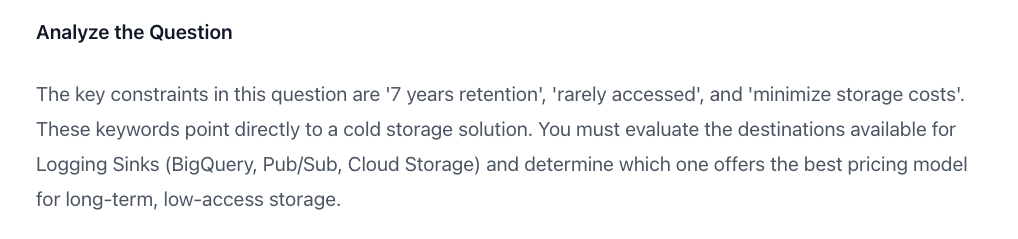
2. Analyze the Question: Modeling Metacognitive Task Analysis
Beginners often feel lost because they do not know how to identify the critical clues in an architectural
prompt. My Analyze the Question section acts as a worked example. It breaks down the scenario,
highlights the diagnostic trigger phrases and models how an expert thinks through a problem.
3. Knowledge Up: Schema Building and Pre-Training
Confronting novices with complex questions causes cognitive overload. To fix this, I added a
learning / Knowledge Up section that provides pre-training on core concepts (such as contrasting
regression
versus time-series forecasting) before the learner tackles the question. This helps learners build the
necessary mental schema first, reducing unnecessary mental strain.
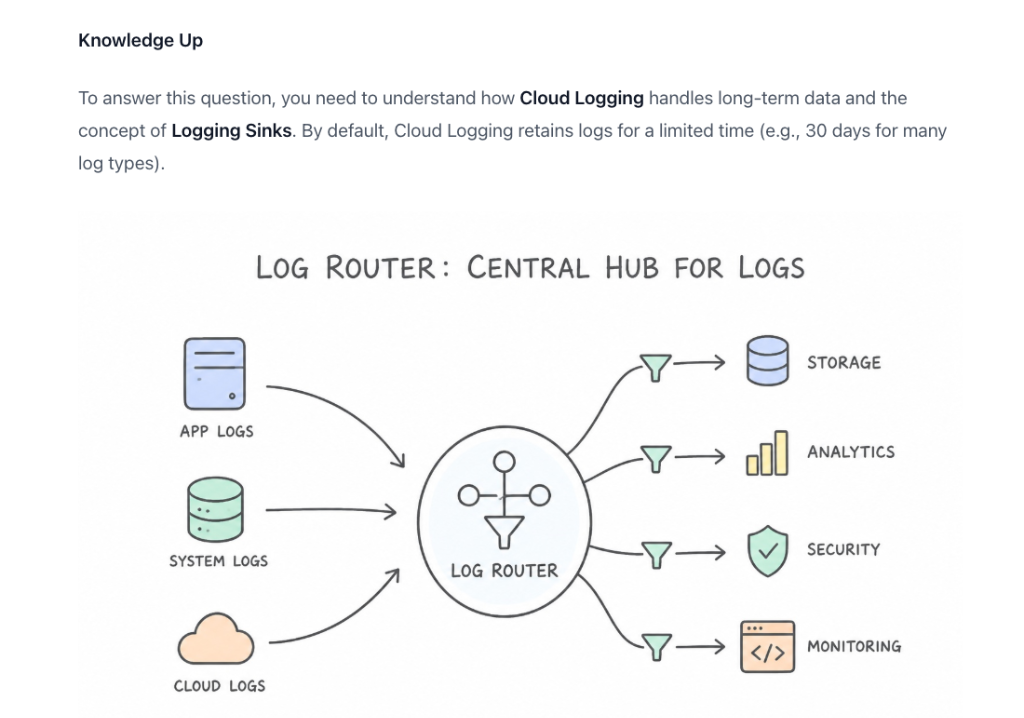
4. Explanatory Illustrations: Dual Coding
Dense technical explanations can overwhelm working memory. I pair complex architectural explanations with clear diagrams. Presenting concepts through both visual and verbal channels helps learners build clearer mental models.
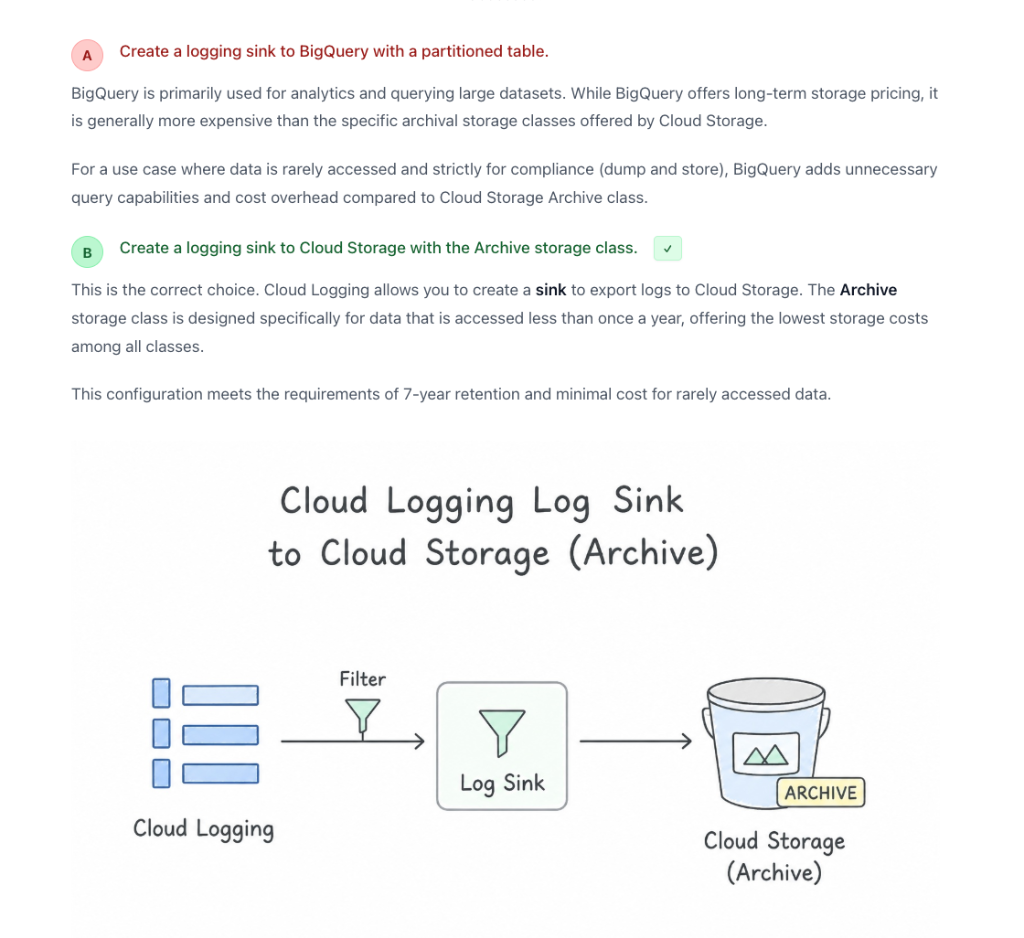
5. Detailed Explanation of Options, right and wrong: Complete Corrective Feedback
Right or wrong checkmarks do not fix misconceptions. On AwesomeGCP, every distractor has a detailed explanation of why it fails in that scenario. This neutralizes errors, eliminates confusion between similar cloud tools, and prevents mistaken ideas from sticking.
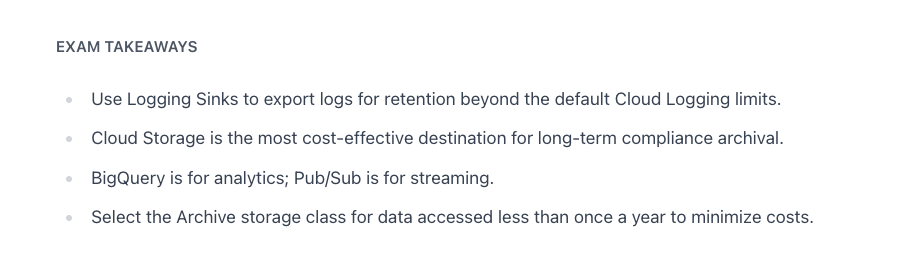
6. Takeaways: Far Transfer
To prevent learners from focusing only on one narrow question, the takeaways section summarizes
the overarching rule. Instead of just memorizing that ARIMA_PLUS solved this retail problem, the learner
abstracts the general principle: continuous targets with timestamps and seasonality require univariate
time-series models. This supports far transfer to unfamiliar questions on certification exams.
Fading Scaffolding Over Time
As learners gain experience, keeping full explanations and guided hints causes the expertise reversal effect, where extra help becomes a distraction. To move learners from beginner status to certification readiness, I designed this progression:
Stage 1: The Guided Scaffold (Novice)
- Learner State: Low prior knowledge; building initial schemas.
- Scaffolding:
Knowledge Upacts as full teaching mode. Rich diagrams and full option-by-option explanations are provided.Takeawaysgive you over-arching ideas.
Stage 2: Prompted Deconstruction (Intermediate)
- Learner State: Knows some concepts and products/services, but needs practice choosing between them.
- Scaffolding:
tldrgives quick feedback.Analyze the Questionprompts the learner to find the constraints themselves.Knowledge Upexpands your knowledge base.Takeawaysreinforce over-arching ideas.
Stage 3: Independent Retrieval (Advanced)
- Learner State: Solid understanding of core services; mastering trade-offs and edge cases.
- Scaffolding:
tldrgives quick feedback and you can skip details on topics you understand.
Stage 4: Exam Simulation and Far Transfer (Certification-Ready)
- Learner State: Preparing for the real exam environment and independent work tasks.
- Scaffolding: Timed questions presented with zero upfront hints. Upon submission, you assess where you stand.
AwesomeGCP.com Learning
The approach taken is a question-led learning approach: you explore realistic project scenarios where you need to make decisions or take actions to achieve business goals within specific constraints. Instead of passive learning, you are challenged to think and work through the options. This impresses concepts and knowledge more deeply, and equips you with the ability to do well at your work or ace the exam!
Additional Resources
- AwesomeGCP Sample Questions: AwesomeGCP Samples
- AwesomeGCP Video Playlists & Guides: AwesomeGCP YouTube Channel